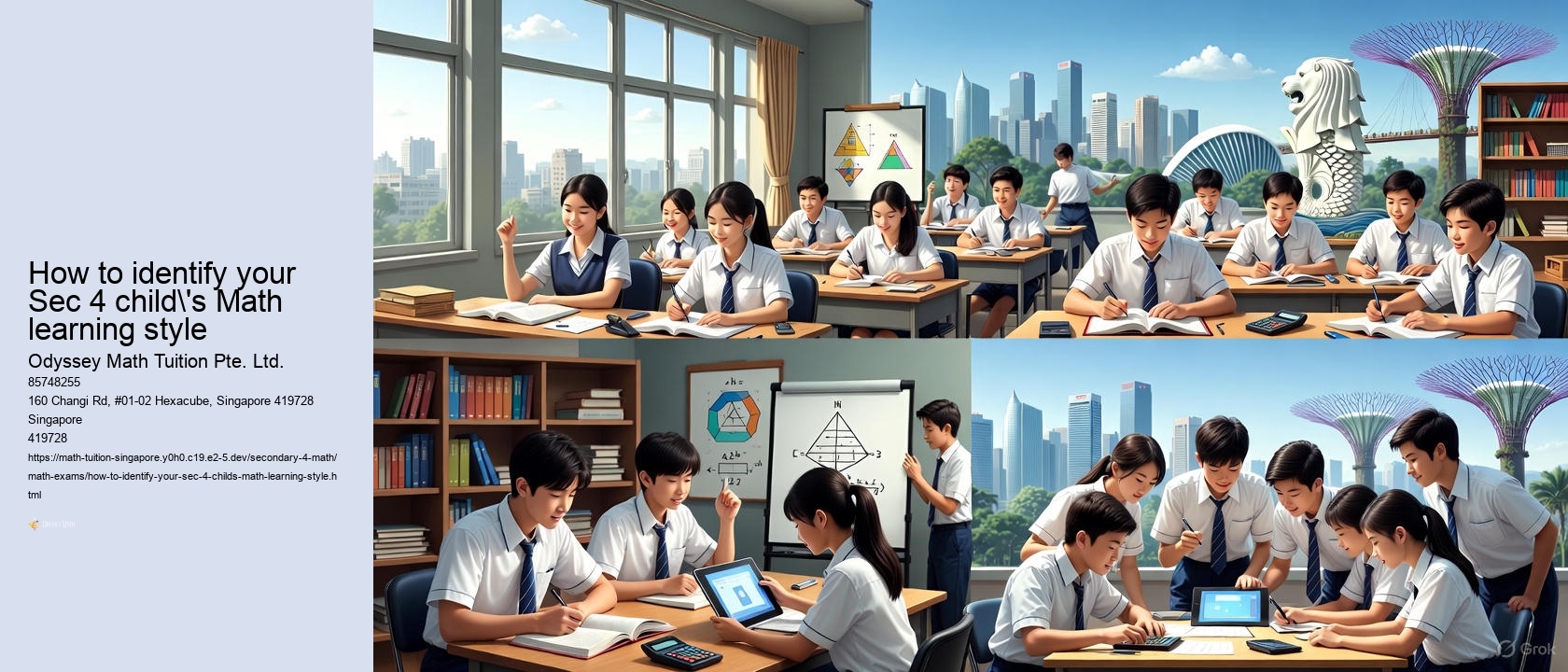
Sec 4. The year that looms large in every Singaporean student's mind, especially when it comes to Math. It's not just about passing; it's about setting the stage for Junior College, polytechnic, or even that dream career in the future. And let's be real, in this day and age with AI breathing down our necks, a solid grasp of mathematics is more crucial than ever. So, how lah, do we help our kids not just survive, but thrive in Sec 4 Math? It all starts with understanding how they learn best.
Think of it like this: everyone has a preferred way of absorbing information. Some kids are visual learners, needing to see the concepts to understand them. Others are auditory, grasping things better through listening. Then you have the kinesthetic learners who need to do, to get hands-on with the material. And finally, the read/write learners who prefer to learn through texts. This is the VARK model – Visual, Auditory, Kinesthetic, Read/Write – and identifying your child's preferred style is the first step on the path to how to excel in Singapore Secondary 4 Math.
Why is this so important? Because forcing a visual learner to learn solely from textbooks, or an auditory learner to only solve problems in silence, is like trying to fit a square peg into a round hole. It just won't work lor! Tailoring your parental support to their learning style can make all the difference in their confidence and grades. And trust me, a little tailored support goes a long way in helping them conquer those challenging Sec 4 Math topics.
Fun Fact: Did you know that the Singapore Math curriculum is consistently ranked among the top in the world? This emphasis on problem-solving and critical thinking makes understanding your child's learning style even more crucial for success!

Okay, so you know about learning styles. In the challenging world of Singapore's education system, parents are progressively concentrated on equipping their children with the skills essential to succeed in challenging math syllabi, encompassing PSLE, O-Level, and A-Level studies. Recognizing early signals of struggle in areas like algebra, geometry, or calculus can bring a world of difference in fostering resilience and mastery over complex problem-solving. Exploring reliable Singapore math tuition options can provide personalized guidance that corresponds with the national syllabus, guaranteeing students acquire the boost they require for top exam performances. By emphasizing dynamic sessions and regular practice, families can help their kids not only meet but go beyond academic standards, clearing the way for upcoming possibilities in competitive fields.. Now what? Here are some practical strategies you can implement to support your Sec 4 child, tailored to their specific learning style:
Interesting Fact: Many famous mathematicians throughout history, like Albert Einstein, have emphasized the importance of visualizing mathematical concepts. This highlights the power of combining different learning styles for a deeper understanding.
Remember, Sec 4 Math isn't just about memorizing formulas; it's about developing problem-solving skills and critical thinking abilities. And by understanding your child's learning style and providing tailored support, you're giving them the best possible chance to ace their exams and unlock their full potential. So, jia you, parents! You've got this!
So, your Sec 4 child is staring down the barrel of the 'O' Levels, lah? And Math, that beast of burden, is giving everyone a headache? Don't worry, auntie/uncle, you're not alone! In Singapore, Math is like the king of the jungle – crucial for PSLE, 'N' Levels, 'O' Levels, JC, poly... basically, your whole academic life! And with AI breathing down our necks, understanding Math isn't just about acing exams; it's about future-proofing your child's career. But how do you help them conquer this mathematical mountain, especially if they learn differently?
Some students just *get* Math when they see it. These are your visual learners. They thrive on diagrams, charts, and anything that transforms abstract concepts into tangible images. Think of it this way: while others are struggling to decipher equations, your visual learner is already picturing the graph in their head. They often have a strong sense of colour, spatial awareness, and can easily recall information presented visually. Spotting these visual cues early is key to how to excel in Singapore Secondary 4 Math.
Characteristics of a Visual Learner:
Fun Fact: Did you know that the Singapore Math curriculum, known for its concrete-pictorial-abstract approach, actually caters well to visual learners? It emphasizes understanding concepts through visual representations before moving on to abstract equations.
Alright, so you suspect your child is a visual learner. Now what? Time to unleash your inner Math-support guru! Here are some parental support strategies for Sec 4 Math, tailored for the Singapore context:
Forget rote memorization! Encourage your child to translate word problems into diagrams. For example, geometry problems become much easier to solve when you can *see* the shapes and angles. For algebra, try using bar models or visual representations of equations. Khan Academy and YouTube channels dedicated to Singapore Math are goldmines for visual explanations.
Mind maps are fantastic for summarizing complex topics and showing the relationships between different concepts. Encourage your child to create mind maps for each chapter, linking key formulas, theorems, and problem-solving techniques. This visual overview helps them see the bigger picture and understand how everything fits together.
A rainbow of notes isn't just pretty; it's practical! Use different colours to represent different types of information – formulas, definitions, examples, etc. This helps visual learners quickly locate and recall specific details. Highlighters are your best friend here!
In this day and age, cannot ignore technology, right? There are tons of online resources and apps that cater to visual learners. GeoGebra is a fantastic tool for exploring geometry and algebra visually. Many tuition centres in Singapore also use interactive whiteboards and visual simulations to teach Math concepts. Embrace these resources to make learning more engaging and effective.
Interesting Fact: The use of abacuses in ancient civilizations, including those in Asia, demonstrates that even centuries ago, people understood the power of visual aids in understanding numbers and calculations!
Let's dive a little deeper into specific strategies you can use to help your visual learner child excel in Singapore Secondary 4 Math:
Make sure your child's study space is visually appealing and organized. Minimize distractions and use visual cues to promote focus. A whiteboard or corkboard can be a great place to display formulas, diagrams, and mind maps.
Don't just passively look at diagrams; actively engage with them. Encourage your child to redraw diagrams, label key elements, and explain the concepts in their own words. This active visualization reinforces understanding and improves retention.
Math isn't just abstract equations; it's all around us! Point out examples of mathematical concepts in everyday life. Architecture, nature, even the design of a HDB flat can illustrate geometric principles. In Singapore's bilingual education system, where proficiency in Chinese is crucial for academic success, parents frequently look for methods to support their children master the lingua franca's intricacies, from word bank and comprehension to essay writing and speaking proficiencies. With exams like the PSLE and O-Levels setting high benchmarks, prompt assistance can avoid common obstacles such as poor grammar or minimal interaction to traditional elements that enrich knowledge acquisition. For families aiming to elevate outcomes, exploring Singapore Chinese tuition resources offers knowledge into structured programs that match with the MOE syllabus and cultivate bilingual assurance. In a modern time where lifelong skill-building is essential for career growth and personal improvement, top schools globally are breaking down barriers by providing a abundance of free online courses that encompass diverse subjects from digital studies and commerce to social sciences and wellness disciplines. These programs enable learners of all experiences to tap into high-quality lectures, tasks, and materials without the economic load of conventional admission, commonly through systems that offer flexible timing and dynamic components. Discovering online universities free courses opens opportunities to prestigious universities' expertise, enabling self-motivated individuals to improve at no cost and earn certificates that improve profiles. By making elite instruction openly available online, such initiatives foster global equality, support underserved populations, and cultivate creativity, demonstrating that high-standard education is increasingly just a tap away for anybody with online access.. This targeted support not only enhances exam preparedness but also instills a more profound respect for the language, unlocking doors to cultural heritage and future occupational edges in a diverse community.. This helps visual learners see the relevance of Math and makes it more engaging.
How to excel in Singapore Secondary 4 Math: Remember, consistent practice is key, but tailoring that practice to your child's learning style is what will truly unlock their potential. By understanding and supporting their visual learning preferences, you can help them conquer Math and pave the way for a brighter future. Don't give up, okay? Your child can do it!
Visual learners benefit from diagrams, charts, and color-coded notes. Encourage your child to create mind maps for complex topics like trigonometry or calculus. Using online simulations and videos can also enhance their understanding and retention of Sec 4 Math concepts.
Parents can support their child's Sec 4 Math learning by providing a dedicated study space and minimizing distractions. Offer encouragement and celebrate small victories to boost their confidence. Consider seeking professional help if your child is struggling with specific topics.
Kinesthetic learners learn best through hands-on activities and movement. Encourage your child to use manipulatives or build physical models to understand geometric concepts. Taking short breaks to move around and solve problems on a whiteboard can also be beneficial.
Auditory learners thrive when listening to explanations and discussions. Suggest that your child record their notes and replay them while studying. Participating in group study sessions and explaining concepts aloud can reinforce their knowledge of Sec 4 Math.
Auditory learners thrive when information is presented through sound. In this bustling city-state's bustling education landscape, where pupils face intense stress to succeed in numerical studies from early to advanced tiers, discovering a tuition facility that integrates proficiency with true passion can create a huge impact in fostering a passion for the field. Enthusiastic educators who go beyond mechanical memorization to motivate strategic reasoning and problem-solving abilities are scarce, but they are vital for assisting pupils surmount challenges in areas like algebra, calculus, and statistics. For guardians hunting for this kind of dedicated assistance, PSLE math tuition stand out as a symbol of devotion, powered by educators who are deeply engaged in every learner's progress. This consistent dedication turns into tailored instructional approaches that adjust to individual demands, resulting in better performance and a long-term appreciation for numeracy that reaches into prospective scholastic and career endeavors.. As Singaporean parents, observe if your Sec 4 child remembers mathematical formulas better after hearing them explained aloud rather than reading them. Do they often hum or talk to themselves while studying? This could indicate a preference for processing information through auditory channels. Understanding this preference is the first step in helping them how to excel in singapore secondary 4 math.
Leverage lectures and discussions to reinforce Math concepts. In this island nation's challenging education landscape, where English serves as the primary medium of instruction and assumes a crucial position in national exams, parents are enthusiastic to support their youngsters overcome typical obstacles like grammar affected by Singlish, lexicon shortfalls, and difficulties in interpretation or composition creation. Establishing robust foundational competencies from elementary levels can significantly elevate confidence in tackling PSLE elements such as contextual composition and verbal interaction, while secondary pupils profit from targeted practice in book-based review and persuasive compositions for O-Levels. For those hunting for effective strategies, delving into singapore math tuition agencies provides valuable perspectives into curricula that sync with the MOE syllabus and stress interactive education. This extra guidance not only hones assessment methods through mock exams and input but also encourages domestic practices like everyday book and conversations to cultivate long-term language proficiency and educational success.. Encourage your child to actively participate in class, asking questions and engaging in verbal explanations. Consider recording lectures (with permission, of course!) so they can revisit challenging topics at their own pace. This simple strategy can significantly enhance their understanding and retention, especially when preparing for crucial exams like the 'O' Levels.
Create a home environment conducive to verbal explanations. When helping with homework, focus on explaining the steps aloud rather than just showing them the solution. Encourage your child to verbalize their thought process as they solve problems; this helps solidify their understanding and identify areas where they might be struggling. After all, sometimes talking it out is the best way to 'siam' (avoid) those tricky Math problems!
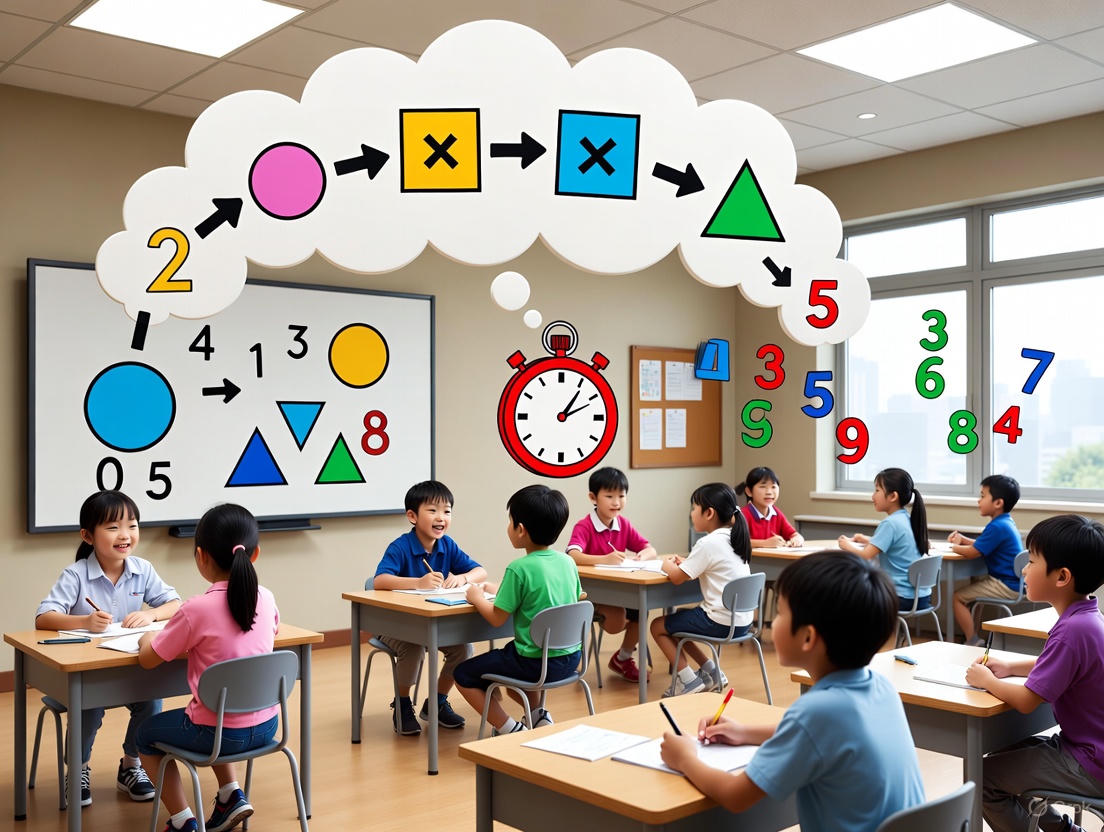
Promote active listening skills. Teach your child to focus on the speaker, avoid distractions, and take concise notes during explanations. Encourage them to summarize key points in their own words to ensure comprehension. Active listening isn't just useful for Math; it's a valuable skill that will benefit them throughout their academic journey and beyond, even when AI is explaining concepts to them!
Integrate audio resources into their study routine. Explore online Math tutorials, podcasts, and even create their own recordings explaining concepts to themselves. Encourage them to listen to these resources while commuting or during breaks. By supplementing traditional study methods with auditory learning tools, you can create a more engaging and effective learning experience, ensuring they are well-prepared to tackle the challenges of Sec 4 Math and beyond, paving the way for future success in a world increasingly driven by mathematical and analytical skills.
Alright, parents, *leh*! Secondary 4 Math. It's like the Everest of Singaporean education, right? And you want your child to not just climb it, but plant a flag at the top! In this era of AI taking over the world, being good at Math is no longer just about getting a good grade. It's about setting your child up for a future where they can truly thrive. But here's the thing: everyone learns differently. And if your child is a kinesthetic learner, well, textbooks alone ain't gonna cut it. They need to *feel* the Math, not just see it.
Think of your child. In Singapore's fiercely demanding academic landscape, parents are dedicated to aiding their youngsters' success in key math tests, beginning with the basic hurdles of PSLE where issue-resolution and conceptual grasp are examined intensely. As students advance to O Levels, they face increasingly complicated areas like geometric geometry and trigonometry that necessitate precision and analytical skills, while A Levels introduce sophisticated calculus and statistics requiring profound comprehension and implementation. For those resolved to giving their offspring an academic edge, locating the tuition customized to these programs can change educational experiences through concentrated approaches and specialized insights. This commitment not only boosts assessment outcomes across all levels but also imbues enduring quantitative proficiency, creating opportunities to prestigious schools and STEM fields in a information-based society.. Do they: * Fidget during long study sessions? * Learn better when they're moving around? * Enjoy hands-on projects more than lectures? * Struggle to focus when sitting still for extended periods? * Remember things better when they've physically done something related to it? If you answered "yes" to most of these, chances are, you've got a kinesthetic learner on your hands. These kids learn best by doing, touching, and experiencing. Traditional sit-down learning can feel like torture to them.
Fun Fact: Did you know that some studies suggest that kinesthetic learners make up a significant portion of the population? It's not just a niche learning style; it's how many people naturally absorb information!
Okay, so you know your child is a kinesthetic learner. Now what? Here's how to turn their learning style into a superpower to *how to excel in singapore secondary 4 math*: * **Manipulatives are Your Friend:** Forget abstract concepts! Bring in the real world. Algebra looking scary? Use building blocks to represent variables. Geometry getting confusing? Get out the ruler, protractor, and compass! Hands-on activities are key for kinesthetic learners. * **Real-Life Applications:** Connect Math to everyday life. Calculating the best discount at the supermarket? That's percentages in action! Figuring out how much paint you need for a room? That's area and volume! Singapore is all about practical application, so embrace it. Show them how Math is used in engineering, finance, and even cooking! *How to excel in singapore secondary 4 math* is all about making it relevant. * **Movement-Based Learning:** Get them moving! Walk through a problem, use gestures to explain concepts, or even bounce a ball while reciting formulas. Anything to get their body involved. * **Build Models:** For geometry, physics and even calculus, building models is a super way for them to understand the subject better. * **Flashcards and Active Recall:** Have them create flashcards and walk around the room while reciting the information. This combines visual and kinesthetic learning. * **Use Technology:** There are many interactive math apps and websites that allow students to manipulate objects and explore concepts in a hands-on way.
Interesting Fact: The abacus, one of the earliest calculating tools, is a fantastic example of kinesthetic learning in action! Moving the beads helps visualize and understand mathematical operations.
Your role as a parent is crucial in helping your child succeed. Here are some parental support strategies for Sec 4 Math: * **Create a Supportive Environment:** Understand that your child learns differently. Be patient and encouraging, and celebrate their successes. * **Collaborate with Teachers:** Talk to your child's Math teacher to understand their learning style and how you can support them at home. * **Seek Professional Help:** If your child is struggling, consider getting them a tutor who understands kinesthetic learning. * **Make it Fun:** Learning doesn't have to be a chore. Find ways to make Math enjoyable, such as playing Math-related games or watching educational videos. * **Focus on Conceptual Understanding:** Instead of rote memorization, encourage your child to understand the underlying concepts. This will help them apply their knowledge to different problems. * **Encourage Peer Teaching:** Have your child explain math concepts to their friends or family members. This is a great way for them to solidify their understanding and identify any gaps in their knowledge. * **Subtopic: The Importance of Math in the Age of AI:** With AI becoming increasingly prevalent, strong math skills are more important than ever. From data analysis to algorithm development, math is the foundation of many AI technologies. By mastering math, your child will be well-equipped to succeed in the future job market. * **Encourage your child to teach you or other family members the concepts they are learning.** This reinforces their understanding and helps them identify areas where they may need more clarification.
History Moment: Ada Lovelace, considered the first computer programmer, was a mathematician! Her understanding of mathematical principles allowed her to envision the potential of computers beyond simple calculations.
If you're considering tuition, make sure the tutor is aware of your child's learning style. Look for tutors who: * Use hands-on activities and manipulatives. * Connect Math to real-world examples. * Encourage movement and active participation. * Focus on understanding concepts, not just memorizing formulas. * Are patient and supportive. Remember, *how to excel in singapore secondary 4 math* isn't about cramming information. It's about understanding and applying it. And for kinesthetic learners, that means getting their hands dirty and experiencing the Math firsthand. So go on, *lah*, help your child unlock their Math potential! With the right approach, they can conquer that Everest and build a bright future for themselves.
Is your Sec 4 child glued to their textbooks, furiously scribbling notes? Or perhaps they’re always surrounded by stacks of flashcards, meticulously crafted and colour-coded? If so, you might just have a read/write learner on your hands! In Singapore, where the pressure to kiasu (fear of losing out) is real, understanding your child's learning style is half the battle won in helping them how to excel in singapore secondary 4 math. And let's face it, math is the foundation for so many future careers, especially with AI becoming so prevalent these days. Don't play play!
Students who thrive on reading and writing often exhibit these attributes:
For these learners, the act of reading and writing solidifies their understanding. It's like, the information goes in through their eyes and hands, and then gets cemented in their brains! So, how can you, as a supportive Singaporean parent, leverage this learning style to help them ace their O-Level Math?
Here are some practical tips, tailored for the Singaporean education system, to help your read/write learner conquer Sec 4 Math:
These strategies are particularly effective because they align with the structured approach often emphasized in Singaporean exam preparation. Our education system, while demanding, also provides ample opportunities for students to excel with the right techniques. This is how to excel in singapore secondary 4 math
Fun Fact: Did you know that the concept of using symbols in mathematics, which is fundamental to algebra, evolved over centuries? Early mathematicians like the Egyptians and Babylonians used rhetorical algebra, where problems were described in words rather than symbols. The symbolic algebra we use today only became widespread in the 16th and 17th centuries!
Being a supportive parent is crucial, especially during the stressful Sec 4 year. Here are some Parental Support Strategies for Sec 4 Math :
Remember, every child learns differently. By understanding your child's learning style and providing the right support, you can help them unlock their full potential and how to excel in singapore secondary 4 math. Jiayou!
Alright, parents, lah! Sec 4 Math. It's crunch time! Remember those Primary School Math problems that seemed like the end of the world? Well, Secondary 4 Math is a whole new level, and it's not just about getting good grades; it's about setting your child up for future success. In today’s world, swimming in AI technologies, a strong Math foundation is like having a super-powered cheat code for life. Want your child to ace those exams and unlock doors to amazing careers? Then, let's dive into understanding how your child learns best – their Math learning style.
Forget cookie-cutter approaches! Every student is different, like a unique plate of Chicken Rice. Some kids are visual learners, others are auditory, and some learn best by doing. Here's how to play detective and figure out your child's dominant learning style:
Fun Fact: Did you know that the concept of zero, so crucial in Math, wasn't always around? It took centuries for mathematicians to fully embrace it, and its adoption revolutionized calculations and paved the way for modern computing!
Parents, you are the ultimate cheerleaders! Here’s how you can provide the support your child needs to excel in Sec 4 Math. This is all about teamwork, can?
Instilling a growth mindset is key. Encourage your child to view challenges as opportunities for growth, not as signs of failure. Remind them that effort and persistence are more important than innate talent. "Eh, never give up lah! Practice makes perfect, you know?"
Interesting Fact: The Golden Ratio, approximately 1.618, appears everywhere in nature, from the spirals of seashells to the arrangement of sunflower seeds. It's also used in art and architecture to create aesthetically pleasing designs! Math is truly all around us.
Okay, let's get down to the nitty-gritty. Here are some tips and tricks to help your child conquer Sec 4 Math:
History Moment: Did you know that Singapore's education system has consistently ranked among the best in the world in Math and Science? This is a testament to the country's commitment to quality education and its focus on developing problem-solving skills.
Alright, parents, let's talk about something real important: your Sec 4 child's attitude towards Math. In Singapore, acing those 'O' Levels is like the golden ticket, right? And Math? Confirm plus chop, it's a subject that can make or break that ticket! But beyond just grades, a positive attitude and a growth mindset are what will truly set your child up for success, not just in Math, but in life lah!
Think about it: we're living in the age of AI. Algorithms are everywhere, and understanding the logic behind them – which is basically Math – is becoming more crucial than ever. Whether your child dreams of being a doctor, an engineer, a programmer, or even an entrepreneur, a solid foundation in Math is non-negotiable. That’s how to excel in Singapore secondary 4 math.
So, how do we cultivate this growth mindset and positive attitude? It's not about pushing them to get that A1 (though, of course, we all want that!). It's about fostering a love for learning and building resilience. It's about celebrating effort, not just results. It's about teaching them that mistakes are opportunities to learn and grow. This is a crucial part of Secondary 4 math tuition tips.
Fun Fact: Did you know that Singapore consistently ranks high in international Math assessments like the Trends in International Mathematics and Science Study (TIMSS)? This shows the effectiveness of our Math curriculum, but also highlights the pressure our students face! Siao liao, right?
Okay, parents, listen up! Here's your action plan for supporting your Sec 4 Math warrior:
Interesting Fact: The history of mathematics in Singapore is intertwined with the country's rapid economic development. The government recognized early on the importance of a strong STEM (Science, Technology, Engineering, and Mathematics) education, leading to significant investments in Math education and teacher training.
Every child learns differently. Understanding your child's learning style can significantly impact how you support their Math learning journey. This is key for how to excel in Singapore secondary 4 math.
Encourage your child to replace negative self-talk ("I'm bad at Math") with positive affirmations ("I can learn this if I keep practicing"). Help them develop a growth mindset by focusing on their ability to improve with effort. This is a practical tip on how to excel in Singapore secondary 4 math.
Remember, parents, your support is crucial. By fostering a growth mindset and a positive attitude, you're not just helping your child ace their 'O' Levels Math; you're equipping them with the skills and resilience they need to succeed in a rapidly changing world. Can or not? Can!
Observe how your child approaches Math problems, their preferred study methods, and whether they grasp concepts better through visual aids, auditory explanations, or hands-on activities.
Common learning styles include visual (using diagrams and notes), auditory (listening to explanations), kinesthetic (hands-on practice), and logical (understanding underlying principles).
Identifying their learning style allows you to tailor their study methods and tuition approaches for more effective learning and better exam results.
Use diagrams, charts, graphs, and color-coded notes to help them visualize concepts and relationships, making abstract ideas more concrete.
Encourage your child to listen to Math explanations, participate in discussions, record and replay lectures, or explain concepts aloud to reinforce understanding.
Use manipulatives, build models, or act out problems to engage their sense of touch and movement, making learning more interactive and memorable.
Emphasize the underlying principles and logic behind formulas and theorems, encouraging your child to question and understand the why behind the how.
Yes, many students benefit from a combination of learning styles. Experiment with different approaches to find what works best for your child.
A tutor can observe your childs learning patterns, adapt their teaching methods accordingly, and provide personalized strategies to maximize learning effectiveness.
Online learning style quizzes, educational psychologists, and experienced Math tutors can provide assessments and guidance to determine your childs preferred learning style.